Colored Shadows

Colored Shadows
Grade Levels
10th Grade, 11th Grade, 12th Grade, 5th Grade, 6th Grade, 7th Grade, 8th Grade, 9th Grade
Course, Subject
Related Academic Standards
Content Provider
To Do and Notice
Turn on the lights, and adjust the positions of the bulbs until you obtain the "whitest" light on the area of the screen where the three lights mix. For best results, make the room as dark as possible.
Place a narrow opaque object, like a pencil, fairly close to the screen. Adjust the distance from the screen until you see three distinct colored shadows.
Remove the object, turn off one of the colored lights, and notice how the color on the screen changes. Then replace the object in front of the screen and notice the color of the shadows. Move the object close to the screen until the shadows overlap. Notice the color of these combined shadows.
Repeat the previous step with a different light turned off while the other two remain on, and then a third time so you have tried all combinations. Repeat again with only one color at a time on, and then with all three on. Vary the size of the object and the distance from the screen. Try using your hand as an object.
Place a narrow opaque object, like a pencil, fairly close to the screen. Adjust the distance from the screen until you see three distinct colored shadows.
Remove the object, turn off one of the colored lights, and notice how the color on the screen changes. Then replace the object in front of the screen and notice the color of the shadows. Move the object close to the screen until the shadows overlap. Notice the color of these combined shadows.
Repeat the previous step with a different light turned off while the other two remain on, and then a third time so you have tried all combinations. Repeat again with only one color at a time on, and then with all three on. Vary the size of the object and the distance from the screen. Try using your hand as an object.
Description
When two different-colored lights shine on the same spot on a white screen, the light reflecting from that spot to your eyes is called an additive mixture because it contains the colors from both lights. We can learn about human color perception by using colored lights to make additive color mixtures.
Materials
- White surface. (A white wall, white posterboard, or white paper taped to stiff cardboard works well. Do not use a beaded or metal slide projection screen.)
- Red, green, and blue lightbulbs or floodlamps, one of each color. Sylvania #11 colored lightbulbs or General Electric Dichrocolor Dichroic Floodlamps (150 watt) work well. We have even obtained excellent results with clear-colored Christmas tree lights. Smaller or dimmer bulbs are fine for tabletop use by a few students, but larger, brighter bulbs allow a larger-scale demonstration.
- 3 light sockets of any type or arrangement that will get the light from the three bulbs simultaneously directed onto the same area of a white surface.
- Any solid object such as a pencil, ruler, correction fluid bottle, finger, etc.
- Adult help.
Duration
20 minutes
Assembly
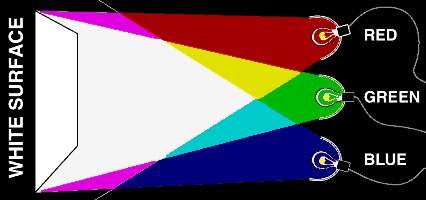
Set up the bulbs and screen in such a way that the light from all three bulbs falls on the same area of the screen and all bulbs are approximately the same distance from the screen. For best results, put the green bulb in between the red and the blue bulbs.
Content Collections
What's Going On?
The retina of the human eye has three receptors for colored light: One type of receptor is most sensitive to red light, one to green light, and one to blue light. With these three-color receptors we are able to perceive more than a million different shades of color.
When a red light, a blue light, and a green light are all shining on the screen, the screen looks white because these three colored lights stimulate all three color receptors on your retinas approximately equally, giving us the sensation of white. Red, green, and blue are therefore called additive primaries of light.
With these three lights you can make shadows of seven different colors: blue, red, green, black, cyan (blue-green), magenta (a mixture of blue and red), and yellow (a mixture of red and green). If you block two of the three lights, you get a shadow of the third color: Block the red and green lights, for example, and you get a blue shadow. If you block all three lights, you get a black shadow. And if you block one of the three lights, you get a shadow whose color is a mixture of the two other colors. If the blue and green mix, they make cyan; red and blue make magenta; red and green make yellow.
If you turn off the red light, leaving only the blue and green lights on, the lights mix and the screen appears to be cyan, a blue-green color. When you hold the object in front of this cyan screen, you will see two shadows: one blue and one green. In one place, the object blocks the light coming from the green bulb and therefore leaves a blue shadow; in another place, it blocks the light from the blue bulb to make a green shadow. When you move the object close to the screen, you will get a very dark (black) shadow, where the object blocks both lights.
When you turn off the green light, leaving the red and blue lights on, the screen will appear to be magenta, a mixture of red and blue. The shadows will be red and blue.
When you turn off the blue light, leaving the red and green lights on, the screen will appear to be yellow. The shadows will be red and green.
It may seem strange that a red light and a green light mix to make yellow light on a white screen. A mixture of red and green light stimulates the red and green receptors on the retina of your eye. Those same receptors are also stimulated by yellow light --- that is, by light from the yellow portion of the rainbow. When the red and green receptors in your eye are stimulated, whether by a mixture of red and green light, or by yellow light alone, you will see the color yellow.
When a red light, a blue light, and a green light are all shining on the screen, the screen looks white because these three colored lights stimulate all three color receptors on your retinas approximately equally, giving us the sensation of white. Red, green, and blue are therefore called additive primaries of light.
With these three lights you can make shadows of seven different colors: blue, red, green, black, cyan (blue-green), magenta (a mixture of blue and red), and yellow (a mixture of red and green). If you block two of the three lights, you get a shadow of the third color: Block the red and green lights, for example, and you get a blue shadow. If you block all three lights, you get a black shadow. And if you block one of the three lights, you get a shadow whose color is a mixture of the two other colors. If the blue and green mix, they make cyan; red and blue make magenta; red and green make yellow.
If you turn off the red light, leaving only the blue and green lights on, the lights mix and the screen appears to be cyan, a blue-green color. When you hold the object in front of this cyan screen, you will see two shadows: one blue and one green. In one place, the object blocks the light coming from the green bulb and therefore leaves a blue shadow; in another place, it blocks the light from the blue bulb to make a green shadow. When you move the object close to the screen, you will get a very dark (black) shadow, where the object blocks both lights.
When you turn off the green light, leaving the red and blue lights on, the screen will appear to be magenta, a mixture of red and blue. The shadows will be red and blue.
When you turn off the blue light, leaving the red and green lights on, the screen will appear to be yellow. The shadows will be red and green.
It may seem strange that a red light and a green light mix to make yellow light on a white screen. A mixture of red and green light stimulates the red and green receptors on the retina of your eye. Those same receptors are also stimulated by yellow light --- that is, by light from the yellow portion of the rainbow. When the red and green receptors in your eye are stimulated, whether by a mixture of red and green light, or by yellow light alone, you will see the color yellow.
Etcetera
Find out what happens when you use different colored paper for the screen. Try yellow, green, blue, red, purple, and so on.
If you let light from the three bulbs shine through a hole in a card that is held an appropriate distance from the screen, you will see three separate patches of colored light on the screen, one from each lamp. (Make the hole large enough to get a patch of color you can really see.) If you move the card closer to the screen, the patches of light will eventually overlap and you will see the mixtures of each pair of colors.
If you let light from the three bulbs shine through a hole in a card that is held an appropriate distance from the screen, you will see three separate patches of colored light on the screen, one from each lamp. (Make the hole large enough to get a patch of color you can really see.) If you move the card closer to the screen, the patches of light will eventually overlap and you will see the mixtures of each pair of colors.