Take It From the Top- How does this stack up?

Take It From the Top- How does this stack up?
Grade Levels
10th Grade, 3rd Grade, 6th Grade, 7th Grade, 8th Grade
Course, Subject
Related Academic Standards
Content Provider
To Do and Notice
Stack the blocks evenly on top of one another to make a vertical column. Position the stack so that you are facing the long side of the blocks. Start at the top of the stack. Move the top block to the right so it overhangs the second block as far as possible without falling. Now move the top two blocks to the right as a unit so they overhang the third block as far as possible without falling. Move the top three blocks, and continue on down the stack. How many blocks must you move before the top block is completely beyond the balance point?
Notice that you can never move a given block over as far as you moved the previous one. The larger the stack of blocks you are moving, the smaller the distance you can move them before they become unbalanced and topple over.
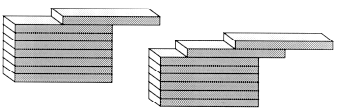
Notice that you can never move a given block over as far as you moved the previous one. The larger the stack of blocks you are moving, the smaller the distance you can move them before they become unbalanced and topple over.
Description
Simple wooden blocks can be stacked so that the top block extends completely past the end of the bottom block, seemingly in a dramatic defiance of gravity. To make this work, you must start moving the top block first and then proceed on down the stack, rather than starting from the bottom up. A mathematical pattern can be noted in the stacking.
Materials
- Approximately 15 to 20 uniform, flat, and rectangular blocks. (The particular size is not crucial, as long as all blocks are the same. We have found that 1 x 4 x 9 inch [2.5 x 10 x 22.5 cm] finished pine works well.)
Duration
20-30 minutes
Assembly
- Stack the blocks evenly on top of one another to make a vertical column. Position the stack so that you are facing the long side of the blocks.
- Start at the top of the stack. Move the top block to the right so it overhangs the second block as far as possible without falling.
- Now move the top two blocks to the right as a unit so they overhang the third block as far as possible without falling. Move the top three blocks, and continue on down the stack. How many blocks must you move before the top block is completely beyond the balance point?
- Notice that you can never move a given block over as far as you moved the previous one. The larger the stack of blocks you are moving, the smaller the distance you can move them before they become unbalanced and topple over
Content Collections
What's Going On?
When you move the top block over so that it just balances, its center of gravity, or balance point, rests over the edge of the block below. Each time you move a block over, you are finding the center of gravity of a new stack of blocks - the block you move plus the blocks above it. The edge of each block acts as a fulcrum supporting all the blocks above it.
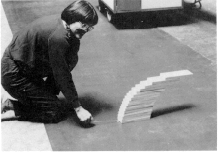
By considering the positions of the centers of gravity of the blocks as the stack is built, it can be shown that the first block will be moved 1/2 of a block length along the second block, the top two blocks will be moved 1/4 of a block length along the third block, the top three blocks will be moved 1/6 of a block length along the fourth block, the top four blocks will be moved 1/8 of a block length along the fifth block, and so on. Do you see the pattern?
How far will the nth block be moved along the block below it? The answer is: 1/2n of a block length along the n + 1 block. Unavoidable experimental error due to factors such as nonuniformity of blocks and inexact location of balance points will lead to actual values that are not quite in agreement with theory but that are still probably close enough to make the point.
By considering the positions of the centers of gravity of the blocks as the stack is built, it can be shown that the first block will be moved 1/2 of a block length along the second block, the top two blocks will be moved 1/4 of a block length along the third block, the top three blocks will be moved 1/6 of a block length along the fourth block, the top four blocks will be moved 1/8 of a block length along the fifth block, and so on. Do you see the pattern?
How far will the nth block be moved along the block below it? The answer is: 1/2n of a block length along the n + 1 block. Unavoidable experimental error due to factors such as nonuniformity of blocks and inexact location of balance points will lead to actual values that are not quite in agreement with theory but that are still probably close enough to make the point.
Etcetera
Textbooks provide an instantly available set of uniform "blocks." Teachers might try stacking the books as we have described when passing them out to students.
Other readily available stackable objects include flat rulers, index cards, or playing cards. You can also cut pieces of matte board or masonite to any desired size; this method is particularly handy if you want to make lots of smaller sets for individual use.
If you want to have some fun, glue together a duplicate set of the blocks that you stacked earlier. You can do this quickly with hot glue. Place the glued stack on top of a loose block that has a strong string attached to a screw eye in one end. You now have a great inertia demonstration. If you jerk the bottom block out swiftly, you won't upset the stack. Practice this a few times first, though! Also, be careful that the block you jerk doesn't hit someone! You will likely have more success if you position the bottom block with the screw eye facing away from the overhanging portion, rather than below it. You might also consider fudging a little by not quite moving each block to its extreme balance point before gluing it. If you manage to jerk the bottom block out before your audience discovers that the stack is glued, they will think that this is an amazing feat. (A little creative showmanship and acting can set the stage for this!) You can also find the center of gravity of the glued stack, and show that the pivot point of the whole glued stack is directly under the center of gravity.
Other readily available stackable objects include flat rulers, index cards, or playing cards. You can also cut pieces of matte board or masonite to any desired size; this method is particularly handy if you want to make lots of smaller sets for individual use.
If you want to have some fun, glue together a duplicate set of the blocks that you stacked earlier. You can do this quickly with hot glue. Place the glued stack on top of a loose block that has a strong string attached to a screw eye in one end. You now have a great inertia demonstration. If you jerk the bottom block out swiftly, you won't upset the stack. Practice this a few times first, though! Also, be careful that the block you jerk doesn't hit someone! You will likely have more success if you position the bottom block with the screw eye facing away from the overhanging portion, rather than below it. You might also consider fudging a little by not quite moving each block to its extreme balance point before gluing it. If you manage to jerk the bottom block out before your audience discovers that the stack is glued, they will think that this is an amazing feat. (A little creative showmanship and acting can set the stage for this!) You can also find the center of gravity of the glued stack, and show that the pivot point of the whole glued stack is directly under the center of gravity.