Put First Things First
Put First Things First
Grade Levels
10th Grade, 11th Grade, 12th Grade, 9th Grade
Course, Subject
Career Retention & Advancement
Related Academic Standards
Rationale
The purpose of this lesson is to show students how to develop a personal time schedule that will help them better plan and use their time on and off the job.
Vocabulary
Prioritize
Responsible
Task
Procrastinate
Plan
Time Quadrants
Urgent
Not Urgent
Important
Not Important
Agenda/appointment “book”/technology assistant
Objectives
The student will be able to develop a time schedule for a week that fully meets the criteria of proper schedule development as presented in class.
Lesson Essential Question(s)
- How do you identify your “big rocks”?
- How do you find the time for everything?
- How can anticipating a schedule in advance help you be more efficient and effective?
- How can technology help to design a schedule?
Duration
3 class periods
Materials
Resources
- Book - The 7 Habits of Highly Successful Teens by Sean Covey, ISBN-10: 0684856093, ISBN-13: 978-0684856094
Equipment/Materials
-
Suitcase and a variety items to pack into it
- Large clear container and many different sized balls OR candies
Suggested Instructional Strategies
|
W = |
We are going to think about and plan time using an agenda/planner book so students will learn how important time management is to success. Students will create a weekly plan for completing all of the tasks they are responsible to complete this week, including personal as well as school, work, etc. Students will discuss the knowledge, procedure, and method needed to transfer their schedules to their cell phones.
In order to serve 504, ESL and those students identified with disabilities, the instructor and the special education/special population's staff will consider and identify appropriate goals, adaptations, and student strengths/weaknesses as per individual 504 plans and IEP's to ensure student success. |
|
H = |
Open the lesson with a demonstration of packing a suitcase. |
|
E = |
Discussion and student planning of their own activities for the next week. |
|
R = |
After students have identified goals and tasks, prioritized and planned their tasks, we will rethink this planning method using a follow up demonstration putting in the most important tasks first and then smaller objects. Available technology scheduling aids will be introduced and discussed as options to use in planning a schedule. |
|
E = |
Students will practice sticking with their planner schedule for a week and reflect on its effectiveness after a week of practice. |
|
T = |
Students will each have an individualized plan based on personal goals and activities for the week. |
|
O = |
The teacher moves from two demonstrations to a mode where student are doing their own schedules for the week. |
Instructional Procedures
|
Introduction |
Ask students if they have ever tried to pack a suitcase. Show them an empty suitcase and ask them to help you pack (you can have kids come up and try or ask for directions to follow). Have enough stuff that it will be impossible to pack without a very careful strategy—don’t give them enough time to develop a careful strategy. Explain that we are all travelers in a sense. We all try to pack more and more into our life. Between school, extracurricular activities, teams, clubs, student government, athletics, part-time jobs, rehearsals, helping with siblings and on and on, there is barely time to breathe. And don’t forget you need to talk with your friends, walk the dog and do household chores like cleaning your room. What will you do? Wait for students to give some suggestions. Reaffirm: it’s all about learning to prioritize and manage your time so that your most important things come first, not last. Ask them to look at your suitcase and your stuff again. Tell them that you forgot to tell them what you are packing for. Tell them and then explain that now you have a goal and a specific destination. What will you need to take? What would be nice to have along? What can be left behind? What can be looked at another time? Have students help you identify things that would be important that you take along (things you cannot do without) and not important things (things that you would enjoy to have for the trip). Everything else can be left behind. The suitcase should pack and fit beautifully this time—you can probably throw in another item or two that would be nice to include.
|
Resource #1 Equipment #1 |
|||||||||
| Demonstration |
Explain that if you had revealed the goal beforehand you all would have saved time and gotten more accomplished. Identifying your goals is important. Ask students to write down some goals that they have for this week. Give a few moments for thinking and writing. Move around the room to observe students “to-do” lists. Ask for a volunteer to conduct an experiment for the class (choose someone who has many goals for the week). Show the class the large clear container. Explain that it represents time available for the week. Ask the student to read off some of their goals and planned activities (school included). Pour in small objects first, ask the student to read more goals and activities. Pour in medium objects. Ask the student to read the remainder of the list. Put the large objects into the container (all large objects will not fit). Ask why the goals and commitments didn’t all fit into the container (because the activities were not prioritized and planned for).
|
Equipment #2 |
|||||||||
| Activity |
Ask students draw a line down the center of their paper. Label the left column Urgent and the right column Not Urgent. Ask them to draw another line horizontally. Put "Important" above the horizontal line and put "Not Important" below. Have them look over their “to-do” list and identify the urgent items and the not so urgent items and place them in the chart as they see them. As students do this put the following table on the board:
Ask: Does your chart have any commonalities to mine? (give student time to add ideas provided by the chart) Explain: a. If most of your items are Urgent and Important you tend to be a procrastinator. Procrastinators are addicted to urgency. They like to put things off and put things off until it becomes a crisis. The results of too much stuff in quadrant 1 are: stress and anxiety, burnout and mediocre performance. b. Things that are Urgent but Not Important represent you trying to please everyone in your life. This quadrant is deceptive because urgent things have the appearance of being important. Phone calls and texting are examples. Spending too much time in quadrant 3 results in: Having a reputation for being a “pleaser”, lack of discipline, and feeling like a doormat for others to wipe their feet on. c. Not Urgent and Not Important? The Slacker category. Going to movies, chatting on the Web, or just hanging out are part of a healthy lifestyle. It’s only when they’re done in excess that they become a waste of time. You know when you have crossed that line. The results: lack of responsibility, guilt and flakiness. d. If most of your items are in the Important butNot Urgent category, you are a prioritizer. And that’s where you want to be. Prioritizers are not perfect. They look at everything they have to do and then make sure things important things get done first. They ask, “What are the most important things I need to do this week?” They keep their sights on their long term goals and think of the tasks at hand as mini goals. The result? Feeling in control of your life, balance and high performance. Review: by procrastinating less, you’re going to have less stress. Learn to say no to unimportant things that pull you away from more important ones. You need to relax and kick back, but remember some relaxation time is prioritizing your "to do" list, excessive relaxation is slacking. |
||||||||||
| Activity |
Introduce the Planner/Agenda. Ask students to plan when they are going to accomplish all of the activities on their “to-do” list for the week. Have them schedule each item. Explain that if they take some time each week to plan their week it will make a big difference. a. First the “big rocks” (most important “to-do’s”), mini goals. A good way to ID big rocks is to think through the roles you have: student, friend, family, job, you, team. b. Block out these activities for this week. c. Schedule Everything else. Once you have your big rocks scheduled, all of your other little to-dos, daily tasks and appointments will fill in around them. Demonstrate again using your container and objects. Ask a student volunteer to help. Place the big rocks in first as the student reads their most important activities. Next, add the mid-sized rocks and finally the smallest objects. All should fit in well. Ask students to reflect on learning and challenge them to stick to their plan this week to see how planning works for them. Remind students that Present and discuss a list of careers that include long hours, weekend work, swing shifts, etc. but may have other perks that make them appealing.Emphasize balance of work life and home life and relate the concept to the schedules students must maintain.
|
Formative Assessment
Criteria and goal setting: Question for understanding and knowing the learning target/goal and the criteria for reaching it.
Observation: Observations assist in gathering evidence of student learning and inform instructional planning.
Questioning strategy: An "exit slip" is to be given at the end of a class period to determine students' understanding of the day's lesson or quick checks during instruction such as "thumbs up/down" or "red/green" (stop/go) cards are also examples of questioning strategies that elicit immediate information about student learning.
Self and peer assessment: When students have been involved in criteria and goal setting, self-evaluation is a logical step in the learning process. With peer evaluation, students see each other as resources for understanding and checking for quality work against previously established criteria.
Related Materials & Resources
Website: http://en.wikipedia.org/wiki/First_Things_First_(book)
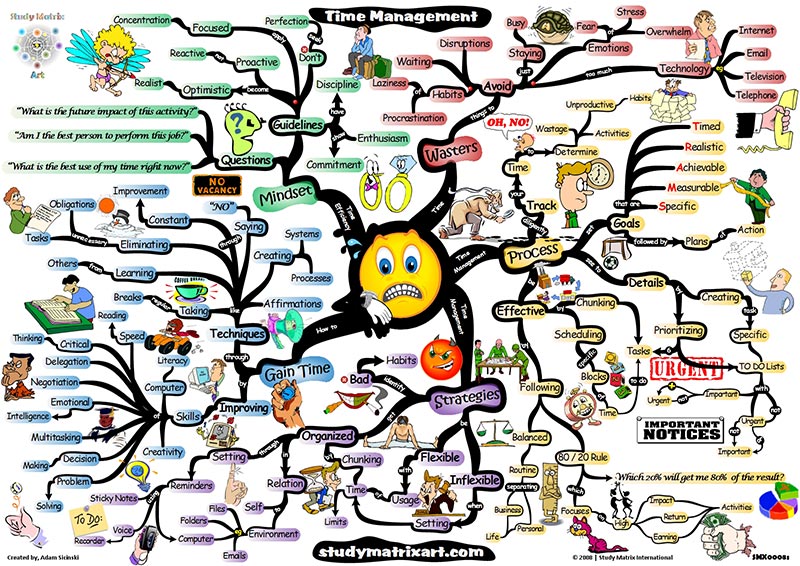
Website: http://croneandbearit.files.wordpress.com/2009/03/time-management-mindmap.jpg
Website: http://www.ehow.com/way_5479939_high-plans-practical-life-skills.html
Website: SAS, Materials & Resources, https://www.pdesas.org/module/content/search/
Website: SAS, Curriculum Framework, https://www.pdesas.org/module/sas/curriculumframework/
Time scheduling,
Prioritizing,
Planning,
Appointments
Author
Susan Fox
Date Published
October 27, 2010